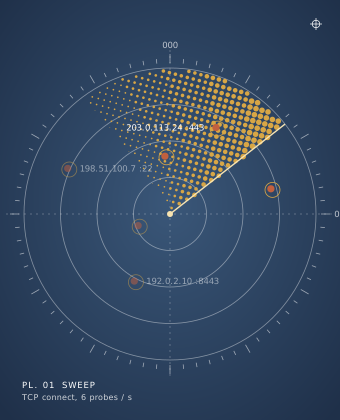
What is being attacked, right now.
Tohou runs its own inbound sensors: hosts on our addresses that accept unsolicited connections and record what the sender tried. They never initiate traffic and never scan. What reaches them tells us which vulnerabilities are being exploited today — often before a CVE appears on any known-exploited list.
The first sensor is being brought online.
Reef publishes nothing until a sensor has been collecting long enough for a verdict to mean something. Rather than show an empty chart, this page stays quiet until there is something real on it.
What will appear here: the vulnerabilities seen under active exploitation in the last 24 hours, with how many distinct sources attempted each one, and the networks those attempts came from.
What a sensor records
- Source addressThe address the connection came from, and the network and country it belongs to.
- What was attemptedThe port, the protocol, and the request — a path, a command, a login attempt.
- Which vulnerabilityWhen a request matches a known exploit, the CVE it targets.
- Client fingerprintHow the client's software is built, which groups one campaign across changing addresses.
What it never does
- No passwords, everAttempted passwords are counted, never stored — not even hashed. People type real credentials at the wrong host constantly.
- No request bodies publishedPayloads can contain other people's data. They stay internal and bounded.
- No sensor addressesPublishing where the sensors are would just teach attackers to avoid them.
- No verdict about a personAn address is not a person. Mobile and shared networks carry thousands of innocent users behind one address.
What this is, and what it isn’t
This is a record of traffic sent to systems Tohou operates. It is not a verdict about an address, its owner or its user, and an address with no record here is not thereby safe. One address is often many people: mobile carriers and shared gateways put thousands of users behind a single one.
Entries age out on their own and stop being published when the activity stops. If an address you control is listed and the problem is fixed, write to [email protected] and we will remove it.
Is any of it aimed at you?
Sonar knows which software and versions run on your assets, so it can tell you not just that something is being exploited, but that the vulnerable version is on your attack surface.
Observed by Tohou’s own sensors. The same data as JSON needs a Tohou API key: https://api.tohou.io/v1/reef/exploited. Counts are rounded and sensor numbers capped on purpose, so the data cannot be used to map where the sensors are.